
What you will learn in this blog article :
- The Value Proposition Canvas is an innovative and effective tool that helps freelancers and self-employed people tailor their offerings to the needs of their target customers.
- With the canvas you gain clarity about the wishes and challenges of your target group , formulate a convincing value proposition and create the basis for sustainable business success .
- Regularly devote time to your Value Proposition Canvas. It will help you stay on track , even in a dynamic market .
Anyone who truly wants to be successful as a freelancer needs more than just talent and perseverance – they need a deep understanding of their clients and their needs. Industry analyses like the
freelancer study by freelance.ca show that project acquisition is the biggest challenge in self-employment.

How the Value Proposition Canvas Supports Acquisition
Many freelancers struggle with self-promotion and networking . Unlike larger companies, they lack the resources and know-how, and at the same time, they don’t have their own sales and marketing teams. This makes it all the more important to channel that energy in a targeted manner so it can flow where it’s truly needed.
This is where the Value Proposition Canvas comes in. It’s a practical thinking and structuring tool that creates clarity and helps freelancers tailor their offerings precisely to the needs of their target audience.
We’ll show you how to use the Value Proposition Canvas for your business – and why it’s so valuable. Once completed, you’ll not only gain a new perspective, but you’ll also be able to incorporate it into your sales process.
More tips and templates for freelancers
The Freelancer Roadmap – the guide for beginners
With interactive tests and helpful templates, we will guide you step by step to successful self-employment
Value Proposition Canvas: The Key to Relevant Offers
As a freelancer, you’re constantly on the move. Clients, projects, tools, requirements—everything changes rapidly. If you want to move beyond reacting and actively shape things, you need clarity: What exactly do I offer? To whom do I work? And why do companies or staffing agencies choose me?
The Value Proposition Canvas provides precisely this clarity by bringing together two key perspectives:
- Your customers’ perspective: What motivates your target audience? What problems do they face? What do they want to achieve?
- Your offer: How does your service specifically help? What benefits do you provide – emotional, functional, and economic?
The goal is to create a perfect match between your offering and customer expectations—the so-called product-market fit. The result: clearer communication, better project completion—and satisfied customers who, ideally, will hire you again or recommend you to others.
What is the Value Proposition Canvas?
The Value Proposition Canvas was developed by Alexander Osterwalder . It focuses on the heart of every business model: the value proposition . Instead of outlining the big picture, it zooms in directly on the customer—and what you specifically offer them. It is therefore the ideal complement to the Lean Canvas , which focuses on the entire business model.
Particularly helpful for freelancers: The canvas forces you to not only describe your target audience abstractly (“marketing manager in an SME” or “CTO in a startup”), but to truly empathize with them. It makes it clear whether your offering solves a real problem—or whether you’re communicating inappropriately.
The Two Sides of the Canvas: Customer Profile & Value Proposition
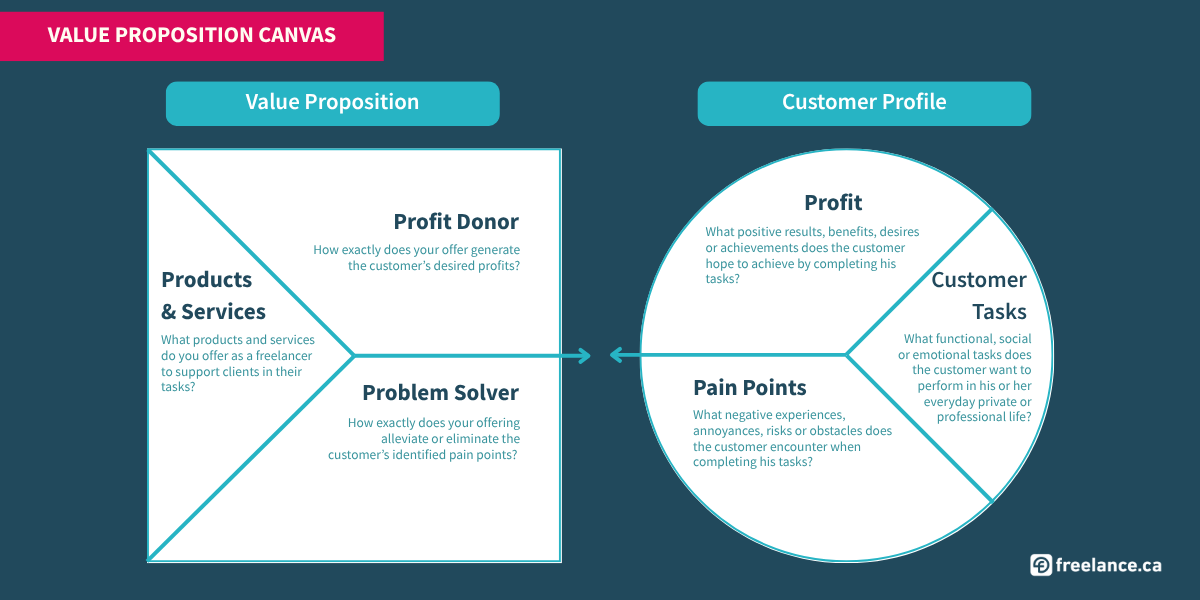
Business Model Canvas by Alexander Osterwalder and Yves Pigneur.
The Value Proposition Canvas consists of two clearly structured areas. Both are closely linked and should be continually reviewed:
1. The Customer Profile: Understanding Your Target Group
Before you offer something, you need to understand who your offer is aimed at. The first part of the canvas helps you develop a precise picture of your target customers:
- Customer tasks: What do your customers want to do, achieve, or solve? These can be professional tasks (e.g., “perform data migration”) or personal goals (e.g., “reduce stress” or “bridge resources”).
- Pain points: What prevents your customers from achieving their goals? What frustrations, fears, or hurdles do they experience? Is there a lack of know-how (e.g., “We need an expert in programming language XY”) or resources (e.g., “Two employees are on parental leave”)? This often represents the greatest leverage for your offering.
- Gains: What positive outcomes do your customers desire? These can be measurable successes (e.g., “We need more sales”) or emotional states (e.g., “Temporary relief would help the team”). What do they desire?
Tip: Use real conversations with your target audience to find the answers. The more specific, the better.
2. The Value Proposition: Sharpen Your Offer
Now change your perspective: How exactly does your offer fit the needs of your customers?
- Products & Services: What exactly do you offer? What form does your service take (e.g., consulting, implementation, training)? What billing model is suitable (e.g., package prices, daily rates, hourly rates)?
- Pain Relievers: How do you simplify your clients’ daily lives (e.g., “knowledge of XY”)? How can you alleviate the challenges described under “Pains” (e.g., “relief during parental leave or during peak seasons”)?
- Gain Creators: How does your service help customers achieve their goals faster, better, or more easily (e.g., “concrete project content that contributes to increased sales”)?
Tip: Step back from your service portfolio and focus on the real customer benefits. Customers don't decide based solely on "10 years of experience" or "programming skills in XYZ," but rather on the added value you provide.
Where Customers and Offers Meet: The Product-Market Fit for Freelancers
On this basis, you formulate your value proposition—that is, how your offer specifically helps alleviate pain and achieve desired gains. A simple formula helps with this:
I help A do B by offering C.
Then test your assumptions in conversations with potential customers. Do your assessments align with reality? Are there any aspects you’ve overlooked? Finally, use the feedback you gather to specifically improve your offering.
Basis for Self-Marketing: The Value Proposition for Freelancers
But you can align more than just your service portfolio based on the Value Proposition Canvas. With a clear customer focus, you optimize your communication because you learn to speak the language of your target audience and clearly convey the added value.
This will help you, for example, with creating your own website or with personal branding . Targeted self-marketing, in turn, increases your closing rate – because people who feel understood are more likely to choose to work with you.
Conclusion: More Clarity, More Customer Focus
The Value Proposition Canvas is a powerful tool for all freelancers who want to build their business with a customer-centric approach. It helps you keep the added value for your target audience in mind when positioning and communicating. At the same time, it doesn’t force you into rigid plans, but rather helps you stay flexible, focused, and relevant in dynamic times.
Last but not least, you will identify new opportunities through intensive engagement with customer needs: By systematically observing where the biggest pain points and desires lie, you will be able to develop targeted, new offerings that solve real problems.