
What you will learn in this blog article :
- The Lean Canvas is an innovative and clear tool for freelancers to structure their business model in a targeted manner and to develop it flexibly.
- The Lean Canvas helps freelancers align their offerings with customer needs, keep track of their most important goals , identify new opportunities early on, and minimize risks.
- On just one page, freelancers receive a compact business roadmap that can be adapted at any time to individual needs and changes in the market.
A business plan? Isn’t one only needed by traditional companies when they apply to banks or investors for financing? Yes and no. That’s true, but it’s only half the story. A clearly structured plan also provides guidance and focus for freelancers – and self-employment is essential without that.
But don’t worry: It doesn’t have to be a page-long, detailed treatise with complex calculations. Perfect for freelancers: the Lean Canvas. We’ll show you how to use this one-pager as your companion and master constantly changing challenges as a freelancer yourself.

Lean Canvas: The Perfect Business Plan for Freelancers
Clarity is the first step to a successful freelance business. If you start your own business without a roadmap, you risk losing track of things in the dynamic daily routine or overlooking important aspects. A well-thought-out business plan brings long-term structure to your day-to-day life and helps you proceed strategically. Exactly what you need if you want to achieve sustained success.
This isn’t about rigid frameworks. The perfect freelancer business plan is a flexible tool that grows with you. That’s why we recommend the Lean Canvas, a compact version of the Business Model Canvas. It helps you distill your business idea and quickly identify which offerings really work and which target groups you’ll reach best. You’ll stay focused on your most important goals—and steer your business confidently into the future.
What is the Lean Canvas?
The Lean Canvas is a living document that guides you not only during the startup phase, but also during the further development of your business idea. Management consultant Ash Maurya introduced it in his 2010 book, Running Lean . He adapted Alexander Osterwalder’s well-known Business Model Canvas specifically for startups.
With the Lean Canvas, founders can clearly present their business model on a single page – a “canvas.” This is particularly helpful for freelancers: the focus is not on the product or service, but on the problem-solving approach . Combined with the unique selling proposition, the Lean Canvas reveals the true potential of the business idea.
- What problems do my customers have?
- How can I solve these problems?
- What advantages do I offer?
- How can I clearly differentiate myself from the competition or other freelancers?
Based on these questions, initial solutions are developed and tested step by step. This allows self-employed people to gather feedback early on and develop their business model in a targeted manner – long before they invest time and resources in the wrong direction.
The fields of the Lean Canvas
Business Model Canvas by Alexander Osterwalder.
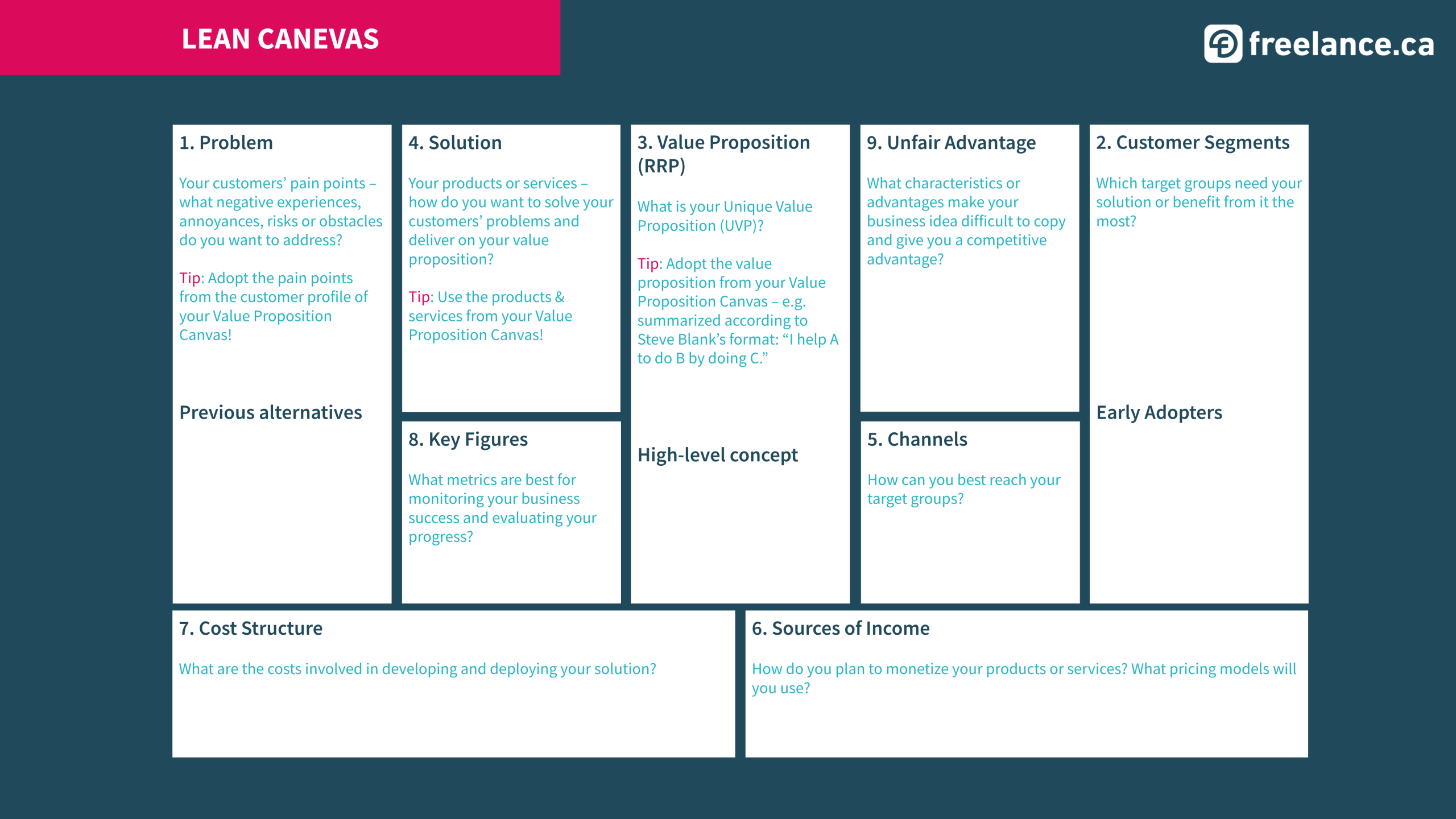
To make the process as simple as possible, the fields of the Lean Canvas follow a logical sequence. This reflects the typical product development process, which can easily be applied to services.
(1) Problem & (2) Customer Segments
First things first: Start by understanding your prospects—not just who they are, but also what
problems they face. This lays the foundation for everything else. After all, you don’t want to develop a solution to a problem no one else has.
Tip: If you have already created a Value Proposition Canvas , you can simply copy the pain points from the customer profile into the Problem field .
(3) Value Proposition
From the identified problems, you then develop the benefits you offer your customers. What added value does the customer get from working with you? What promise do you make to your customers?
Tip: Here, too, you can adopt the value proposition from your Value Proposition Canvas—for example, summarized according to Steve Blank's format: "I help A accomplish B by doing C." Here, A is the customer, B is their problem, and C is your solution.
(4) Solution
The next question is what your value proposition actually means. Explain your solution approach in more detail: How exactly do you intend to solve your customers’ problems? What’s behind the “C”?
(5) Channels
By now, you know who you’re targeting, what problem you’re solving, and how you’re doing it. Now you need to figure out how best to reach your customers. To do this, you should examine different channels . For example, does your target audience use LinkedIn a lot, or do they rely more traditionally on email and phone? Perhaps they use specific platforms for project postings, such as freelance.ca . This information fundamentally influences your acquisition approach.
(6) Sources of Income & (7) Cost Structure
Many freelancers start with a clear vision but don’t think about the financial side until later. The Lean Canvas counteracts this. Consider how you can monetize your solution and what costs will be incurred. What payment and pricing models are you planning? Possible options include project-based billing, daily rates, and hourly rates. The more accurately you fill out this field, the better you can estimate the long-term profitability of your business model—and keep a better eye on your cash flow .
(8) Key Figures
Your business model is in place. But how do you know if you’re actually successful? Set clear
goals and consider how you can measure their achievement. User numbers, revenue, or the number of completed projects, for example, can provide clues. The time frame can also be relevant, for example, if you ‘re testing freelancing as a part-time job and want to evaluate after a certain period of time—say, six months—whether a full-fledged switch to self-employment makes sense. Regular check-ins not only show whether you ‘re on track , but also whether adjusting your business model or, for example, further training might be useful to better achieve your goals.
(9) Unfair Advantage or Unique Selling Point
Finally, describe what makes you unique and difficult to copy—your unique selling proposition . This is often something that only develops or crystallizes over time—but it’s still something you should consider early on. It could be, for example, specialized expertise, a network, or exclusive access to certain resources.
Being a freelancer means one thing above all: flexibility . And this is exactly where the Lean Canvas comes in. You should regularly review the individual areas and adapt them based on your experience and current trends. Because one thing is certain: Those who remain open to change and continually question existing structures can identify new opportunities early on.
Our tip: Structure your ideas early on and, as you become self-employed, take time to continually adapt your business model. The Lean Canvas is your individual compass for your business and should be continually adjusted. Use our template and develop your Lean Canvas today!
More tips and templates for freelancers
The Freelancer Roadmap – the guide for beginners
With interactive tests and helpful templates, we will guide you step by step to successful self-employment